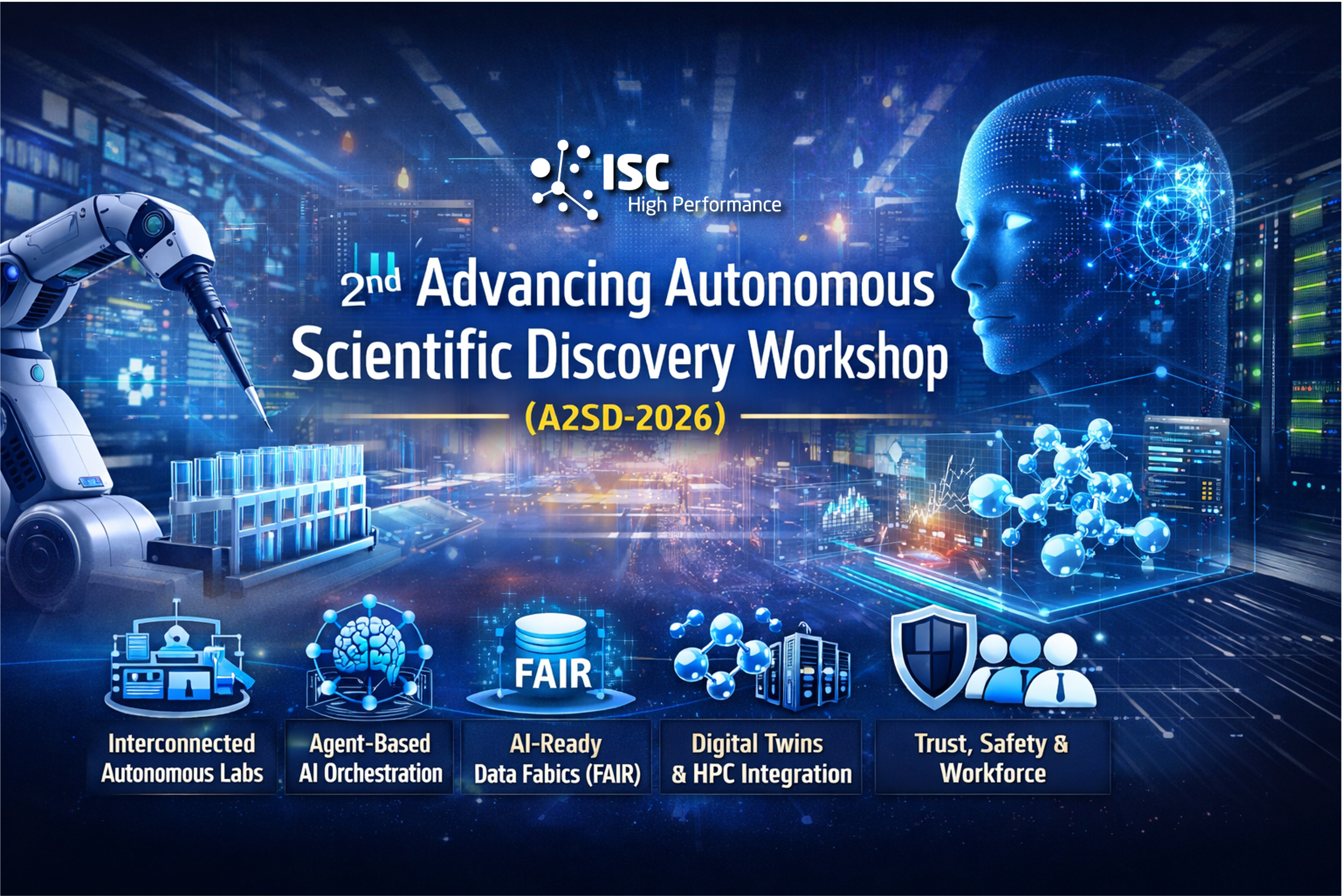
The A2SD-2026 Workshop brings together researchers and practitioners shaping the future of AI-driven, interconnected, and automated scientific ecosystems. As instruments produce complex data streams at rates beyond human response, A2SD-2026 focuses on connected, intelligent, and verifiable autonomous systems that can operate across scientific facilities.
Building on the A2SD-2025 community roadmap and follow-up activities, the workshop highlights five key areas:
- Architectures and standards for interconnected autonomous laboratories at scale;
- Agent-based AI for scientific orchestration (including LLM agents with grounding and verification);
- Distributed data fabrics and AI-ready infrastructure (FAIR-aligned, real-time metadata, interoperability);
- Digital twins and closed-loop experiment-to-compute integration leveraging HPC; and
- Standards, trust, safety, and workforce development for responsible autonomous science.
Invited speakers
 Amanda Randles
Duke University
 Michela Taufer
University of Tennessee Knoxville
 Michael Bussmann
Helmholtz-Zentrum Dresden-Rossendorf
 David Elbert
Johns Hopkins University
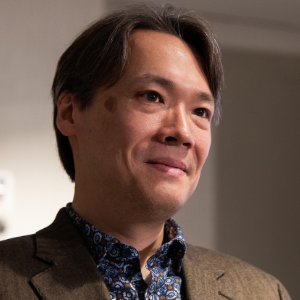 Glenn Lockwood
VAST Data
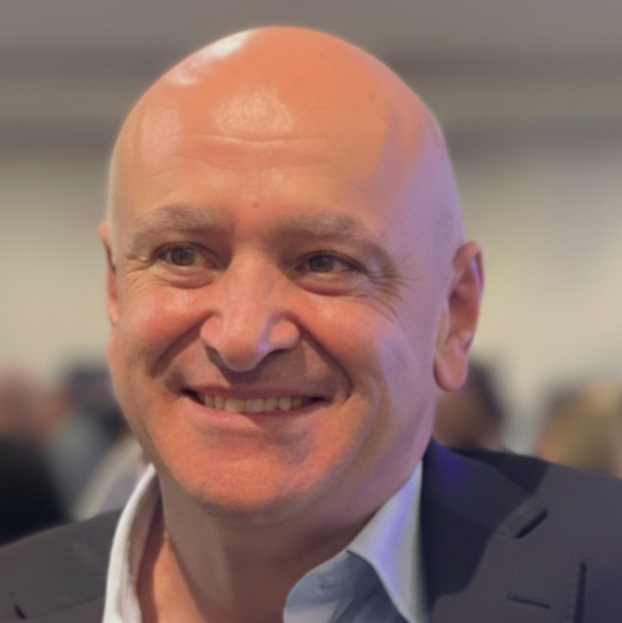 Raffi Nazikian
General Atomics
Program (Preliminary)
Abstract
Scientific discovery has traditionally relied on sparse snapshots of complex systems. In healthcare, this often means isolated measurements taken weeks or months apart despite disease progression occurring continuously over time. Advances in wearable sensing, multimodal data integration, artificial intelligence, and high performance computing are now enabling a new paradigm for continuous physiologic discovery through longitudinal digital twins.
In this talk, I will present our work on large scale cardiovascular digital twins that integrate wearable data, imaging, electronic health records, and physics-based blood flow simulations to reconstruct physiologic trajectories across millions of heartbeats. Rather than treating physiology as a sequence of disconnected states, these approaches enable continuous modeling of evolving patient specific dynamics and cumulative biologic exposure over time.
I will discuss how hybrid AI and physics-based approaches can support autonomous scientific inference, including biomarker discovery, counterfactual testing of interventions, and identification of subtle physiologic changes that are not observable through single time point measurements alone. Finally, I will highlight the computational challenges involved in scaling longitudinal digital twins across heterogeneous HPC architectures and discuss how these technologies may help shift healthcare from reactive treatment toward proactive and predictive care.
Abstract
Scientific workflow infrastructure was built for humans: a researcher submits a job, a scheduler dispatches it, and the researcher waits for results. Autonomous agents break that model entirely by continuously generating tasks and reacting to outcomes without waiting for instruction. As a result, autonomous workflows will quickly encounter a hard architectural limit that human-paced science rarely confronts: centralized orchestration does not scale horizontally.
VAST Data faced this challenge while developing an event-driven workflow system for commercial applications, and we arrived at a simple design principle: event-driven orchestration should be the foundation, and centralized coordination should be reserved only for workflow segments that require it. Implementing this also required rethinking the underlying data infrastructure, particularly around durable event brokering and stateless function dispatch.
In this talk, we present VAST's workflow system, the architectural choices behind it, and how it differs from traditional scientific workflow systems. We then invite discussion on where autonomous science diverges from commercial agentic workflows and what that implies for the infrastructure needs of autonomous science.
Abstract
A core dichotomy facing programmable cloud laboratories is that automation centers on stateless components for modularity while autonomy requires explicit system-level memory for reasoning, adaptation, and scientific meaning. To scale autonomous discovery from individual instruments and isolated laboratories to distributed, multi-facility ecosystems will require embedding state, meaning, provenance, and authorization in workflows that cross computational and physical boundaries. In the AI for Materials Discovery Laboratory (AIMD-L) we approach this challenge through typed events enriched with persistent identifiers, schema validation, uncertainty descriptions, and semantic context. AIMD-L’s central, event-driven, linked-data layer converts data from a passive record into an active control surface to empower: workflow choreography; on-demand materialization of state; and human or agentic reasoning over linked evidence. This creates opportunities for distributed laboratory coordination without brittle, centralized control while turning laboratory events into shared scientific intelligence infrastructure.
Abstract
Until recently, the automation of science at research infrastructures was addressed by user communities and facility operators. In the best case, both groups worked together to optimize facility operation and scientific workflows for a common goal. One of the best-known success stories is particle physics, with large collaborations building few, highly-sophisticated experiments delivering a wealth of data that could then be dissected into many interesting research directions by data analysis and modeling. In a very different model, photon and neutron science usually look at a broad variety of systems and diagnostics to study these systems at research facilities. Here, communities need a lot of time in finding commonalities and creating useful and usable workflows for a diverse group of researchers, beamlines, end stations, diagnostics and systems investigated. Individual researchers and teams have little control on this process. In my talk I want to draw attention to the reasons why our previous attempts to improve this situation have failed and how recent developments in artificial intelligence and high-performance computing can change this dramatically.
Abstract
Fusion science has long been gated by a fundamental asymmetry. A tokamak like DIII-D produces a plasma in seconds, but the physics-based simulations needed to understand it can take days or weeks. Between pulses, with only a brief window to decide what to do next, scientists have largely flown on intuition. The bottleneck is not a shortage of data but a shortage of time to reason over it.
We are now dissolving that bottleneck at the DIII-D National Fusion Facility. Our interactive digital twin uses AI surrogate models, trained on tens of thousands of experimental shots and physics simulations, to predict plasma behavior in near-real-time. These surrogates are deployed to the edge, where live facility data is ingested and a residual-driven architecture continuously compares prediction against measurement, identifying where the physics, or the models, are breaking down.
The frontier now is closing the loop entirely. This includes using those residuals to autonomously trigger new simulations and retraining, push upgraded models back mid-campaign, and let the facility learn as it runs. We will discuss how LLM-based agents are beginning to orchestrate this stack, interpreting twin outputs, proposing between-pulse experiments, and advising operators on how to steer the next pulse.
Abstract
Collaborators: Jack Marquez, Marshall McDonnell, Kin Hong NG, Lance Drane, Giorgio Scorzelli, Amy Gooch, Valerio Pascucci, Ray Gregory, Kaz Gofron, Bogdan Vacaliuc, Zach Thurman, Gregory Cage, Gavin Wiggins, Cody Stiner, Jesse McGaha, Andrew Ayres, Robert Smith, Greg Watson, Addi Malviya Thakur, Yuanpeng Zhang, Jue Liu, Stephen DeWitt, Ankit Shrivastava, Paul Laiu, Craig Bridges, Mathieu Doucet, Matt Tucker, Emily R Van Auken, Luke Daemen, Marie Backman, Darsh Dinger, Melanie Kirkham, Thomas Proffen, Austin McDannald, Gilad Kusne, William Ratcliff, Ben Mintz, Rob Moore
Autonomous “closed-loop” experiments are becoming essential at large facilities, but they require reusable software patterns to move data across trusted boundaries, analyze results in real time, and safely steer instruments.
ORNL and the National Science Data Fabric (under the leadership of the University of Tennessee and the University of Utah) are developing and deploying an adaptive strain-mapping workflow for X-ray scattering on wire-arc additive-manufactured parts at the CHESS Structural Materials Beamline. Experimental data stream through the National Science Data Fabric (NSDF) to computing resources, where INTERSECT@ORNL’s Distributed Active Learning (DIAL) builds a surrogate model and recommends the next measurement locations; the beamline executes them, and the loop repeats.
This talk presents the end-to-end architecture, integration points, and potential “gotchas” (latency, metadata, provenance, and operator controls) so others can replicate the pattern for autonomous experiments and AI-ready pipelines across domains.
Hamburg, Germany
Date: June 26, 2026
Time: 2:00pm-6:00pm CEST
Room: Hall 10 - 1st Floor
Organizers
- Rafael Ferreira da Silva
ORNL - Tom Gibbs
NVIDIA - Michela Taufer
UTK